Here’s why
This is not the first time I’ve written about this subject. Previous related posts are #236, #240 and #241. I’ll make this one a stand-alone post, taking from those previous posts whatever I need. OK, let’s go …
A “fiduciary” means, essentially, someone who acts (usually in a financial capacity) for someone else, with the requirement that the fiduciary must act in the best interests of the client, not for their own self-interest. It comes from the Latin word “fides,” meaning faith or trust. So it gives you, as the client, confidence, knowing you’re placed first.
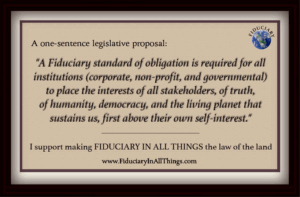
I have this thought on the movement toward a fiduciary society, as embodied in George Kinder’s one-sentence legislative proposal, shown below: It’s an ideal today, but maybe one day it’s an achievable goal, so it’s worth backing from the start. If it comes about, it’ll make the world a better and more trustworthy place to live in, reducing anxiety and freeing up energy to make things even better. Readers and friends agreed – enthusiastically – when I first wrote about it, but they also pointed out all sorts of objections; the one that resonated the most powerfully with me is simply that many organizations and people are self-serving and virtue-signaling rather than behaving as fiduciaries, so: no chance of ever achieving it.
Nevertheless, I joined a steering committee that George set up, and worked with it to collectively come up with a Vision, and for the steering committee a Mission and a Purpose (all in #236).
Now we meet online every month, and after all these months of discussion, the notion has become a natural as well as a visionary part of my life, so I’ve decided to add two things at the end of each blog post, simply to constantly remind myself (and my readers – it’s my way of spreading the word, as I no longer give talks) about the ideal, the vision: the words of George’s legislative proposal, and its own attached logo, as well as another logo. (I like both logos, and don’t need to choose between them!) The sentence that says that I support making FIAT the law of the land is, in a sense, my pledge.
There was one side question I had, right from the first time I saw George’s wording. I have a lot of experience of acting as a fiduciary in a personal capacity. But that’s not where the proposal is directed. Why is FIAT directed toward institutions? It’s because being a fiduciary is, in a way, disguised when it involves an institution. When we do something, it shows that it’s within our power to do it. And when that power is personal, the person who is responsible for any behavior or decision is obvious. But with an institution, it’s far from obvious who is responsible for the use of power. That lack of obvious responsibility is what makes it so important for institutions to adopt FIAT. Otherwise we’ll never know who exactly is not acting in a fiduciary capacity.
Yes, there are lots of obstacles we’ll have to overcome. But George reminds us that FIAT is a vision so powerful that you can’t say no to it. And for something like that, its power helps to make it easier to overcome the obstacles to its implementation.
***
Takeaway
I believe in the Fiduciary In All Things (FIAT) principle.
***
6 Comments
I have written about retirement planning before and some of that material also relates to topics or issues that are being discussed here. Where relevant I draw on material from three sources: The Retirement Plan Solution (co-authored with Bob Collie and Matt Smith, published by John Wiley & Sons, Inc., 2009), my foreword to Someday Rich (by Timothy Noonan and Matt Smith, also published by Wiley, 2012), and my occasional column The Art of Investment in the FT Money supplement of The Financial Times, published in the UK. I am grateful to the other authors and to The Financial Times for permission to use the material here.
I had some hope until I read the plaque. Delete the words “of truth … sustains us” and you have something that might be actionable and more importantly measurable – leave them in and it’s so idealistic that it couldn’t be implemented.
I’ll take the hopeful bit! And then I’ll hope that, over time, we can extend our definition to eliminate harm to other areas of life — and yes, that will be difficult, but it clearly identifies the goal.
I appreciate the sentiment behind the Fiduciary In All Things principle. I am still wrestling to come up with a framework under which it could be implemented. I try to imagine how a corporation, with shareholders, can implement the principle. It seems that the principle gives the interests of the stakeholders (a much larger class than shareholders and one that potentially includes everybody) priority over the interests of shareholders. I can’t understand how that will work. I am not trying to adopt some Milton Friedman-like approach but, rather to understand how to strike a balance.
Thanks. My purpose is to raise the issue for discussion, so that both the benefits and the implementation problems can be identified. And you’ve raised a good one.
U.S. based Fisher Investments promotes itself (on TV) as a “fiduciary” so perhaps they have found some workable solution to this concept. A brief review of their website indicates that their major ‘fiduciary’ strategy is a 100 % fee-based compensation structure. Not sure this meets the challenge.
Well, at least it avoids a conflict of interests in connection with fees, which is a start. But you’re right, by itself it’s not enough to meet the challenge.